
PluriCell East
PluriCell East

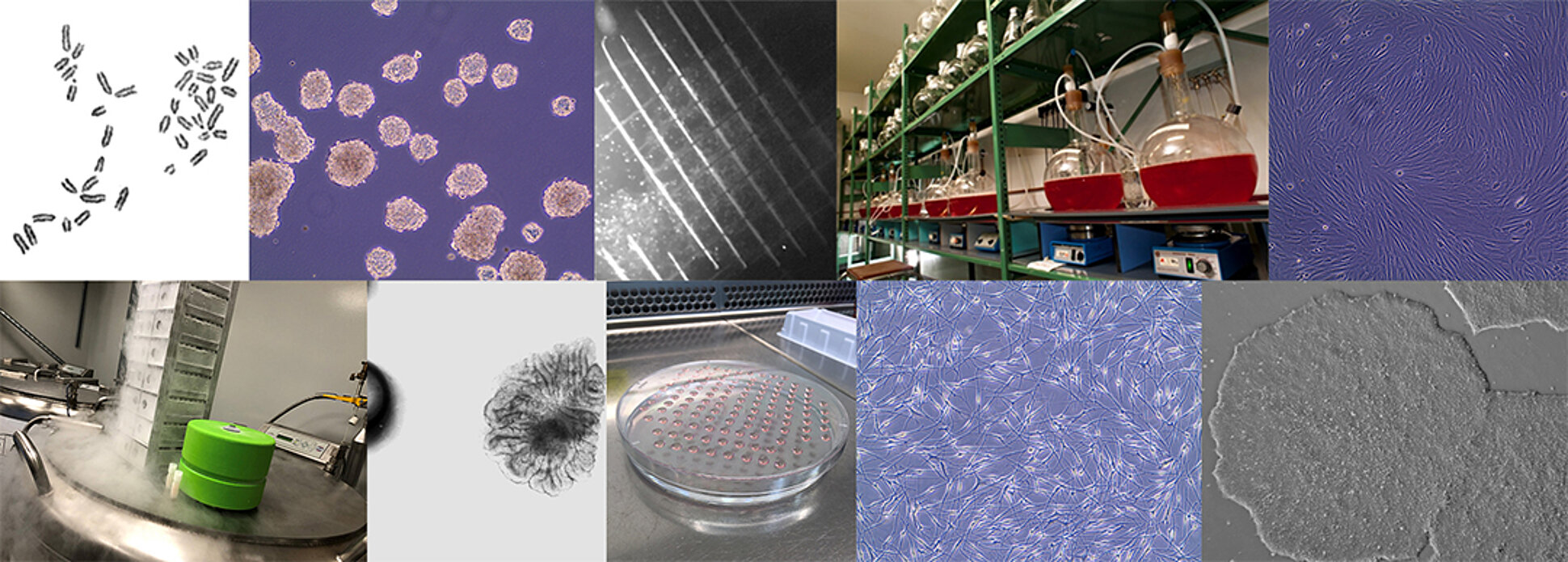
With more than 30 years of expertise in cell culture, the PluriCell East platform provides scientific and technological services and support tailored to the needs of academic and private research communities, both in France and internationally.
PluriCell East maintains a referenced collection of more than 2,400 human and animal cell lines, including normal and tumor cell lines, as well as cell lines derived from patients with genetic diseases. The platform provides services including the culture and storage of primary cells and human and animal cell lines, large-scale suspension cell culture in volumes of up to 25 L, and the production and preparation of culture media. We also provide quality control services and testing of new culture conditions, for example when evaluating new FCS batches or culture media.
These activities rely on rigorous monitoring and management of cell cultures. Cell lines and cultures are registered in our database and are subject to continuous monitoring and traceability throughout their use. Established protocols and procedures are applied to the different stages of cell culture and handling to ensure reproducible practices, reliable project monitoring, and consistent quality of our services.
For more than 10 years, the platform has developed specific expertise in the culture, maintenance, and characterization of pluripotent stem cells, particularly human induced pluripotent stem cells (hiPSCs) and mouse embryonic stem cells (mESCs).
This expertise has been extended to CRISPR-Cas9-based genome editing of hiPSCs. Since the launch of this service in spring 2025, 7 hiPSC genome editing projects have already been completed, including knock-out (KO), knock-in (KI), and base editing approaches. The platform has also recently developed a somatic cell reprogramming service to generate hiPSCs.

The PluriCell East platform provides its expertise as well as scientific and technological support to meet users’ needs.
Cell Culture
- Culture and storage of primary cells and human and animal cell lines, including normal and patient-derived cells.
- Large-scale suspension cell culture, with volumes of up to 25 L.
- Production of LIF (Leukemia Inhibitory Factor).
- Production and preparation of customized culture media.
Pluripotent Stem Cells
- Culture, maintenance, and storage of human induced pluripotent stem cells (hiPSCs) and mouse embryonic stem cells (mESCs).
- CRISPR-Cas9-based genome editing of hiPSCs, including KO, KI, and base editing approaches.
- Reprogramming of somatic cells into hiPSCs.NEW
- Training of users in hiPSCs culture.
- Access to dedicated BSL-2 laboratories for hiPSCs culture.
Cell Culture Quality Control
PluriCell East provides a range of quality control and cell culture characterization services, including:
- Thawing tests
- Mycoplasma detection
- hiPSC characterization
- Karyotyping and chromosome counting
Optimization and Development of Culture Conditions
The platform provides cell culture condition optimization and testing of new products or methods, including materials, culture media, serum batches, and optimization of cell culture techniques.
Project Support
PluriCell East also provides technical and scientific support to researchers throughout their projects.
BSL-2 Laboratories available to users
- 2 BSL-2 laboratories dedicated to hiPSCs culture.
- 1 BSL-2 laboratory dedicated to virus handling.
New
- Somatic Cell Reprogramming into hiPSCs
PluriCell East has developed a new somatic cell reprogramming service for the generation of human induced pluripotent stem cells (hiPSCs).
A first pilot project was carried out using two fibroblast cultures, enabling the platform to establish and validate the experimental conditions required to implement this new service.
120 m² cell culture laboratories (L1 et L2)
- 9 Biological Safety Cabinets HERASAFE KS12 et KS15
- 12 Incubators CO2 Panasonic
- 3 inverted Zeiss Microscopes
- 2 observation system Lynx Stereo Vision Engineering for hiPSC culture
- 1 NucleoCounter NC-202 ChemoMetec
- 1 room at 37°C for large scale suspension cells culture
2 Laboratories L2 dedicated to hiPSC culture:
- 7 Biological Safety Cabinets HERASAFE KS12 et KS15
- 6 incubators CO2 Panasonic
- 1 incubator tri-gas for culture in hypoxia
- 4 Leica observation systems
- 2 Lynx observation system Stereo Vision Engineering
- 1 inverted Microscopes whose 1 fluorescence microscope with camera
For any request to the PluriCell East Platform, please contact us at :
pluricell-east@igbmc.fr
The PluriCell East platform is involved in several regional, national and European networks :
- CoRTeCS (https://cortecs.unistra.fr/)
- CorEuStem (https://coreustem.eu/)
- Cancéropole Grand Est (https://www.canceropole-est.org/)
- GDR organoïdes (https://gdr-organoides.cnrs.fr/)
Publications
2023
Article in a journal
Androgen receptor coordinates muscle metabolic and contractile functions
- Kamar Ghaibour
- Mélanie Schuh
- Sirine Souali‐crespo
- Céline Chambon
- Anouk Charlot
- Joe Rizk
- Daniela Rovito
- Anna‐isavella Rerra
- Qingshuang Cai
- Nadia Messaddeq
- Joffrey Zoll
- Delphine Duteil
- Daniel Metzger
Journal of Cachexia, Sarcopenia and Muscle ; Volume: 14 ; Page: 1707 - 1720
Article in a journal
IL-3 produced by T cells is crucial for basophil extravasation in hapten-induced allergic contact dermatitis
- Carole El Hachem
- Pierre Marschall
- Pierre Hener
- Anupama Karnam
- Srinivasa Reddy Bonam
- Pierre Meyer
- Eric Flatter
- Marie-Christine Birling
- Jagadeesh Bayry
- Mei Li
Frontiers in Immunology ; Volume: 14
Article in a journal
Hypoxia-inducible factor 1A inhibition overcomes castration resistance of prostate tumors
- Julie Terzic
- Mohamed Abu El Maaty
- Régis Lutzing
- Alexandre Vincent
- Rana El Bizri
- Matthieu Jung
- Céline Keime
- Daniel Metzger
EMBO Molecular Medicine
Article in a journal
Structural analysis and biological activities of C25-amino and C25-nitro vitamin D analogs
- Uxía Gómez-Bouzó
- Anna Belorusova
- Marcos L Rivadulla
- Hugo Santalla
- Lieve Verlinden
- Annemieke Verstuyf
- Maria J Ferronato
- Alejandro C Curino
- Maria M Facchinetti
- Yagamare Fall
- Generosa Gómez
- Natacha Rochel
Bioorganic Chemistry ; Volume: 136 ; Page: 106528
Article in a journal
Distinct changes in endosomal composition promote NLRP3 inflammasome activation
- Zhirong Zhang
- Rossella Venditti
- Li Ran
- Zengzhen Liu
- Karl Vivot
- Annette Schürmann
- Juan Bonifacino
- Maria Antonietta de Matteis
- Romeo Ricci
Nature Immunology ; Volume: 24 ; Page: 30-41
Article in a journal
Super-enhancer-driven expression of BAHCC1 promotes melanoma cell proliferation and genome stability
- Pietro Berico
- Maguelone Nogaret
- Max Cigrang
- Antonin Lallement
- Fatemeh Vand-Rajabpour
- Amanda Flores-Yanke
- Giovanni Gambi
- Guillaume Davidson
- Leane Seno
- Julian Obid
- Bujamin H. Vokshi
- Stéphanie Le Gras
- Gabrielle Mengus
- Tao Ye
- Carlos Fernandez Cordero
- Mélanie Dalmasso
- Emmanuel Compe
- Corine Bertolotto
- Eva Hernando
- Irwin Davidson
- ...
Cell Reports ; Volume: 42 ; Page: 113363
Article in a journal
KCNN4 links PIEZO-dependent mechanotransduction to NLRP3 inflammasome activation
- Li Ran
- Tao Ye
- Eric Erbs
- Izabela Sumara
- Romeo Ricci
- Zhirong Zhang
- Stephan Ehl
- Nathalie Spassky
Science Immunology ; Volume: 8 ; Page: adf4699
2022
Article in a journal
Efficient production of protein complexes in mammalian cells using a poxvirus vector
- Robert Drillien
- Karine Pradeau Aubreton
- Julien Batisse
- Joelle Mezher
- Emma Schenckbecher
- Justine Marguin
- Eric Ennifar
- Marc Ruff
PLoS ONE ; Volume: 17
Article in a journal
Ts66Yah, a mouse model of Down syndrome with improved construct and face validity
- Arnaud Duchon
- Maria del Mar Muñiz Moreno
- Claire Chevalier
- Valérie Nalesso
- Philippe Andre
- Marta Fructuoso-Castellar
- Mary Mondino
- Chrystelle Po
- Vincent Noblet
- Marie-Christine Birling
- Marie-Claude Potier
- Yann Herault
Disease Models & Mechanisms ; Volume: 15 ; Page: dmm049721
Article in a journal
The lncRNA LENOX interacts with RAP2C to regulate metabolism and promote resistance to MAPK inhibition in melanoma.
- Giovanni Gambi
- Gabrielle Mengus
- Guillaume Davidson
- Ewout Demesmaeker
- Alessandro Cuomo
- Tiziana Bonaldi
- Vasiliki Katopodi
- Gabriel Malouf
- Eleonora Leucci
- Irwin Davidson
Cancer Research