
PluriCell East
PluriCell East

With more than 30 years of expertise in cell culture, the PluriCell East platform provides scientific and technological services and support tailored to the needs of academic and private research communities, both in France and internationally.
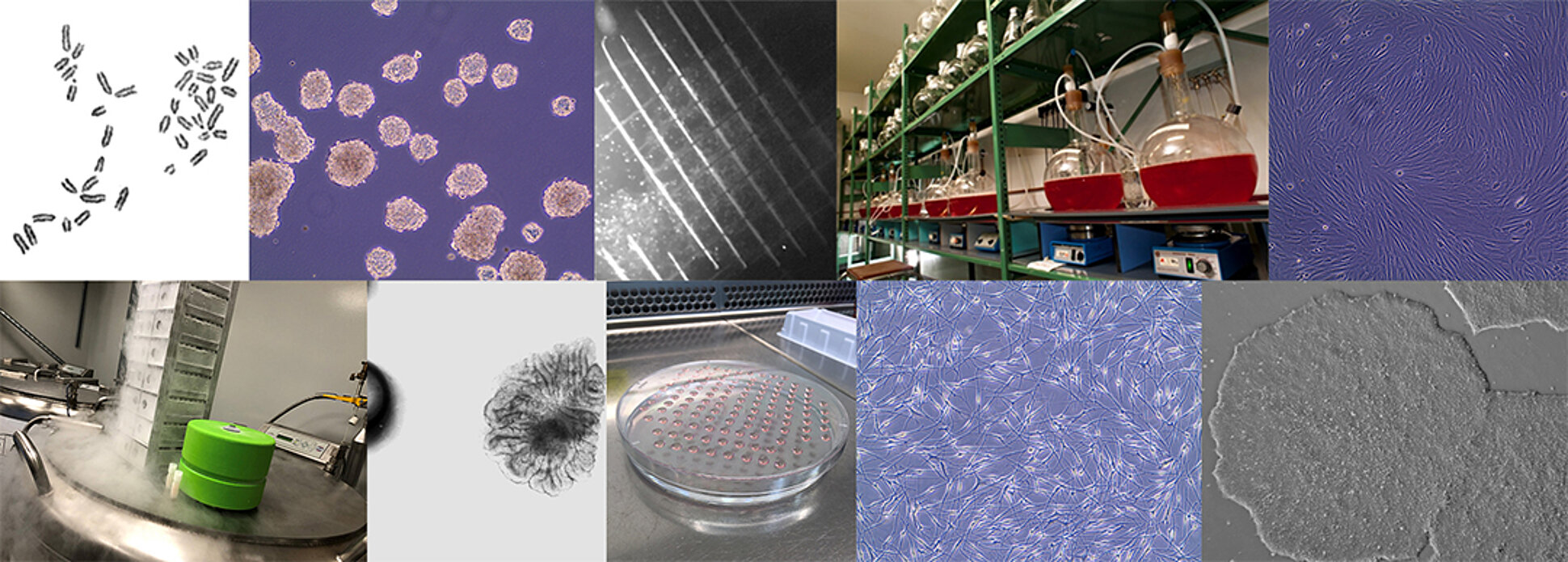
PluriCell East maintains a referenced collection of more than 2,400 human and animal cell lines, including normal and tumor cell lines, as well as cell lines derived from patients with genetic diseases. The platform provides services including the culture and storage of primary cells and human and animal cell lines, large-scale suspension cell culture in volumes of up to 25 L, and the production and preparation of culture media. We also provide quality control services and testing of new culture conditions, for example when evaluating new FCS batches or culture media.
These activities rely on rigorous monitoring and management of cell cultures. Cell lines and cultures are registered in our database and are subject to continuous monitoring and traceability throughout their use. Established protocols and procedures are applied to the different stages of cell culture and handling to ensure reproducible practices, reliable project monitoring, and consistent quality of our services.
For more than 10 years, the platform has developed specific expertise in the culture, maintenance, and characterization of pluripotent stem cells, particularly human induced pluripotent stem cells (hiPSCs) and mouse embryonic stem cells (mESCs).
This expertise has been extended to CRISPR-Cas9-based genome editing of hiPSCs. Since the launch of this service in spring 2025, 7 hiPSC genome editing projects have already been completed, including knock-out (KO), knock-in (KI), and base editing approaches. The platform has also recently developed a somatic cell reprogramming service to generate hiPSCs.

The PluriCell East platform provides its expertise as well as scientific and technological support to meet users’ needs.
Cell Culture
- Culture and storage of primary cells and human and animal cell lines, including normal and patient-derived cells.
- Large-scale suspension cell culture, with volumes of up to 25 L.
- Production of LIF (Leukemia Inhibitory Factor).
- Production and preparation of customized culture media.
Pluripotent Stem Cells
- Culture, maintenance, and storage of human induced pluripotent stem cells (hiPSCs) and mouse embryonic stem cells (mESCs).
- CRISPR-Cas9-based genome editing of hiPSCs, including KO, KI, and base editing approaches.
- Reprogramming of somatic cells into hiPSCs.NEW
- Training of users in hiPSCs culture.
- Access to dedicated BSL-2 laboratories for hiPSCs culture.
Cell Culture Quality Control
PluriCell East provides a range of quality control and cell culture characterization services, including:
- Thawing tests
- Mycoplasma detection
- hiPSC characterization
- Karyotyping and chromosome counting
Optimization and Development of Culture Conditions
The platform provides cell culture condition optimization and testing of new products or methods, including materials, culture media, serum batches, and optimization of cell culture techniques.
Project Support
PluriCell East also provides technical and scientific support to researchers throughout their projects.
BSL-2 Laboratories available to users
- 2 BSL-2 laboratories dedicated to hiPSCs culture.
- 1 BSL-2 laboratory dedicated to virus handling.
New
- Somatic Cell Reprogramming into hiPSCs
PluriCell East has developed a new somatic cell reprogramming service for the generation of human induced pluripotent stem cells (hiPSCs).
A first pilot project was carried out using two fibroblast cultures, enabling the platform to establish and validate the experimental conditions required to implement this new service.
120 m² cell culture laboratories (L1 et L2)
- 9 Biological Safety Cabinets HERASAFE KS12 et KS15
- 12 Incubators CO2 Panasonic
- 3 inverted Zeiss Microscopes
- 2 observation system Lynx Stereo Vision Engineering for hiPSC culture
- 1 NucleoCounter NC-202 ChemoMetec
- 1 room at 37°C for large scale suspension cells culture
2 Laboratories L2 dedicated to hiPSC culture:
- 7 Biological Safety Cabinets HERASAFE KS12 et KS15
- 6 incubators CO2 Panasonic
- 1 incubator tri-gas for culture in hypoxia
- 4 Leica observation systems
- 2 Lynx observation system Stereo Vision Engineering
- 1 inverted Microscopes whose 1 fluorescence microscope with camera
For any request to the PluriCell East Platform, please contact us at :
pluricell-east@igbmc.fr
The PluriCell East platform is involved in several regional, national and European networks :
- CoRTeCS (https://cortecs.unistra.fr/)
- CorEuStem (https://coreustem.eu/)
- Cancéropole Grand Est (https://www.canceropole-est.org/)
- GDR organoïdes (https://gdr-organoides.cnrs.fr/)

Publications
2018
Article in a journal
Post-translational modifications in DNA topoisomerase 2α highlight the role of a eukaryote-specific residue in the ATPase domain
- Claire Bedez
- Christophe Lotz
- Claire Batisse
- Arnaud Vanden Broeck
- Roland Stote
- Eduardo Howard
- Karine Pradeau Aubreton
- Marc Ruff
- Valerie Lamour
Scientific Reports ; Volume: 8
Article in a journal
Disease-causing variants in TCF4 are a frequent cause of intellectual disability: lessons from large-scale sequencing approaches in diagnosis
- Laura Mary
- Amélie Piton
- Elise Schaefer
- Francesca Mattioli
- Elsa Nourisson
- Claire Feger
- Claire Redin
- Magali Barth
- Salima El Chehadeh
- Estelle Colin
- Christine Coubes
- Laurence Faivre
- Elisabeth Flori
- David Geneviève
- Yline Capri
- Laurence Perrin
- Jennifer Fabre-Teste
- Dana Timbolschi
- Alain Verloes
- Robert Olaso
- ...
European Journal of Human Genetics ; Volume: 26 ; Page: 996 - 1006
Article in a journal
Hijacking DNA methyltransferase transition state analogues to produce chemical scaffolds for PRMT inhibitors
- Ludovic Halby
- Nils Marechal
- Dany Pechalrieu
- Vincent Cura
- Don-Marc Franchini
- Céline Faux
- Frédéric Alby
- Nathalie Troffer-Charlier
- Srikanth Kudithipudi
- Albert Jeltsch
- Wahiba Aouadi
- Etienne Decroly
- Jean-Claude Guillemot
- Patrick Page
- Clotilde Ferroud
- Luc Bonnefond
- Dominique Guianvarc’h
- Jean Cavarelli
- Paola Arimondo
Philosophical Transactions of the Royal Society B: Biological Sciences ; Volume: 373 ; Page: 20170072
Chapter of the book
Unstable Protein Purification Through the Formation of Stable Complexes
- Sylvia Eiler
- Nicolas Lévy
- Benoit Maillot
- Julien Batisse
- Karine Pradeau Aubreton
- Oyindamola Oladosu
- Marc Ruff
Methods in Molecular Biology ; Page: 315-328
Article in a journal
UBASH3B-mediated silencing of the mitotic checkpoint: Therapeutic perspectives in cancer
- Ksenia Krupina
- Charlotte Kleiss
- Sushil Awal
- Irene Rodriguez-Hernandez
- Victoria Sanz-Moreno
- Izabela Sumara
Molecular & Cellular Oncology ; Volume: 5 ; Page: e1271494
Article in a journal
Identification of MOSPD2, a novel scaffold for endoplasmic reticulum membrane contact sites
- Thomas Di Mattia
- Léa P. Wilhelm
- Souade Ikhlef
- Corinne Wendling
- Danièle Spehner
- Yves Nominé
- Francesca Giordano
- Carole Mathelin
- Guillaume Drin
- Catherine Tomasetto
- Fabien Alpy
EMBO Reports ; Volume: 19
Article in a journal
Genes and Pathways Regulated by Androgens in Human Neural Cells, Potential Candidates for the Male Excess in Autism Spectrum Disorder
- Angélique Quartier
- Laure Chatrousse
- Claire Redin
- Céline Keime
- Nicolas Haumesser
- Anne Maglott-Roth
- Laurent Brino
- Stephanie Le Gras
- Alexandra Benchoua
- Jean-Louis Mandel
- Amélie Piton
Biological psychiatry ; Volume: 84 ; Page: 239-252
Article in a journal
Imaging of native transcription factors and histone phosphorylation at high resolution in live cells
- Sascha Conic
- Dominique Desplancq
- Alexia Ferrand
- Véronique Fischer
- Vincent Heyer
- Bernardo Reina San Martin
- Julien Pontabry
- Mustapha Oulad-Abdelghani
- Kishore Babu N.
- Graham Wright
- Nacho Molina
- Etienne Weiss
- Laszlo Tora
Journal of Cell Biology ; Volume: 217 ; Page: 1537-1552
2017
Article in a journal
Cockayne’s Syndrome A and B Proteins Regulate Transcription Arrest after Genotoxic Stress by Promoting ATF3 Degradation
- Alexey Epanchintsev
- Federico Costanzo
- Marc-Alexander Rauschendorf
- Manuela Caputo
- Tao Ye
- Lise-Marie Donnio
- Luca Proietti-De-Santis
- Frédéric Coin
- Vincent Laugel
- Jean-Marc Egly
Molecular Cell ; Volume: 68 ; Page: 1054-1066.e6
Article in a journal
Visualization of chemical modifications in the human 80S ribosome structure
- S. Kundhavai Natchiar
- Alexander G. Myasnikov
- Hanna Kratzat
- Isabelle Hazemann
- Bruno P. Klaholz
Nature ; Volume: 551 ; Page: 472-477