
PluriCell East
PluriCell East

With more than 30 years of expertise in cell culture, the PluriCell East platform provides scientific and technological services and support tailored to the needs of academic and private research communities, both in France and internationally.
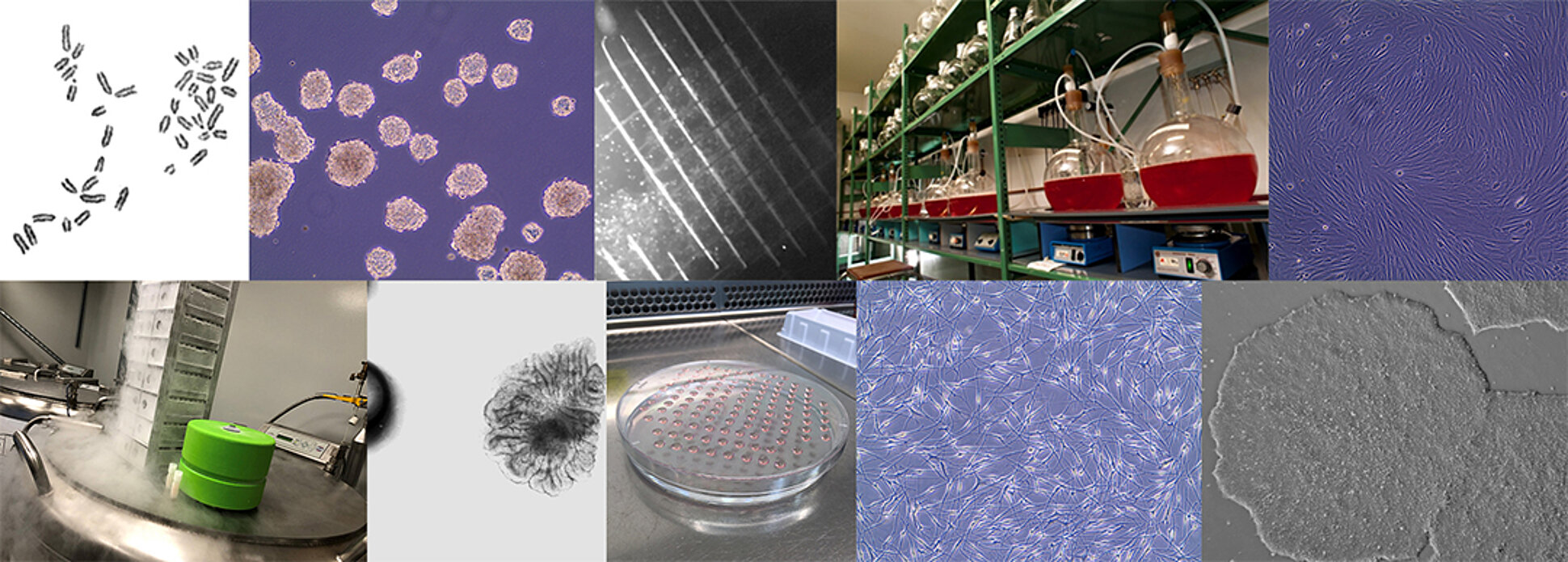
PluriCell East maintains a referenced collection of more than 2,400 human and animal cell lines, including normal and tumor cell lines, as well as cell lines derived from patients with genetic diseases. The platform provides services including the culture and storage of primary cells and human and animal cell lines, large-scale suspension cell culture in volumes of up to 25 L, and the production and preparation of culture media. We also provide quality control services and testing of new culture conditions, for example when evaluating new FCS batches or culture media.
These activities rely on rigorous monitoring and management of cell cultures. Cell lines and cultures are registered in our database and are subject to continuous monitoring and traceability throughout their use. Established protocols and procedures are applied to the different stages of cell culture and handling to ensure reproducible practices, reliable project monitoring, and consistent quality of our services.
For more than 10 years, the platform has developed specific expertise in the culture, maintenance, and characterization of pluripotent stem cells, particularly human induced pluripotent stem cells (hiPSCs) and mouse embryonic stem cells (mESCs).
This expertise has been extended to CRISPR-Cas9-based genome editing of hiPSCs. Since the launch of this service in spring 2025, 7 hiPSC genome editing projects have already been completed, including knock-out (KO), knock-in (KI), and base editing approaches. The platform has also recently developed a somatic cell reprogramming service to generate hiPSCs.

The PluriCell East platform provides its expertise as well as scientific and technological support to meet users’ needs.
Cell Culture
- Culture and storage of primary cells and human and animal cell lines, including normal and patient-derived cells.
- Large-scale suspension cell culture, with volumes of up to 25 L.
- Production of LIF (Leukemia Inhibitory Factor).
- Production and preparation of customized culture media.
Pluripotent Stem Cells
- Culture, maintenance, and storage of human induced pluripotent stem cells (hiPSCs) and mouse embryonic stem cells (mESCs).
- CRISPR-Cas9-based genome editing of hiPSCs, including KO, KI, and base editing approaches.
- Reprogramming of somatic cells into hiPSCs.NEW
- Training of users in hiPSCs culture.
- Access to dedicated BSL-2 laboratories for hiPSCs culture.
Cell Culture Quality Control
PluriCell East provides a range of quality control and cell culture characterization services, including:
- Thawing tests
- Mycoplasma detection
- hiPSC characterization
- Karyotyping and chromosome counting
Optimization and Development of Culture Conditions
The platform provides cell culture condition optimization and testing of new products or methods, including materials, culture media, serum batches, and optimization of cell culture techniques.
Project Support
PluriCell East also provides technical and scientific support to researchers throughout their projects.
BSL-2 Laboratories available to users
- 2 BSL-2 laboratories dedicated to hiPSCs culture.
- 1 BSL-2 laboratory dedicated to virus handling.
New
- Somatic Cell Reprogramming into hiPSCs
PluriCell East has developed a new somatic cell reprogramming service for the generation of human induced pluripotent stem cells (hiPSCs).
A first pilot project was carried out using two fibroblast cultures, enabling the platform to establish and validate the experimental conditions required to implement this new service.
120 m² cell culture laboratories (L1 et L2)
- 9 Biological Safety Cabinets HERASAFE KS12 et KS15
- 12 Incubators CO2 Panasonic
- 3 inverted Zeiss Microscopes
- 2 observation system Lynx Stereo Vision Engineering for hiPSC culture
- 1 NucleoCounter NC-202 ChemoMetec
- 1 room at 37°C for large scale suspension cells culture
2 Laboratories L2 dedicated to hiPSC culture:
- 7 Biological Safety Cabinets HERASAFE KS12 et KS15
- 6 incubators CO2 Panasonic
- 1 incubator tri-gas for culture in hypoxia
- 4 Leica observation systems
- 2 Lynx observation system Stereo Vision Engineering
- 1 inverted Microscopes whose 1 fluorescence microscope with camera
For any request to the PluriCell East Platform, please contact us at :
pluricell-east@igbmc.fr
The PluriCell East platform is involved in several regional, national and European networks :
- CoRTeCS (https://cortecs.unistra.fr/)
- CorEuStem (https://coreustem.eu/)
- Cancéropole Grand Est (https://www.canceropole-est.org/)
- GDR organoïdes (https://gdr-organoides.cnrs.fr/)

Publications
2016
Article in a journal
Structure-function insights reveal the human ribosome as a cancer target for antibiotics
- Alexander Myasnikov
- Kundhavai Natchiar
- Marielle Nebout
- Isabelle Hazemann
- Véronique Imbert
- Heena Khatter
- Jean-François Peyron
- Bruno Klaholz
Nature Communications ; Volume: 7
Article in a journal
TRF2 is recruited to the pre-initiation complex as a testis-specific subunit of TFIIA/ALF to promote haploid cell gene expression
- Igor Martianov
- Amandine Velt
- Guillaume Davidson
- Mohamed-Amin Choukrallah
- Irwin Davidson
Scientific Reports ; Volume: 6
Article in a journal
Novel mutants of the aubergine gene
- H. Bahar Sahin
- Omer Faruk Karatas
- Valeria Specchia
- Silvia Di Tommaso
- Céline Diebold
- Maria Pia Bozzetti
- Angela Giangrande
Fly ; Volume: 10 ; Page: 81-90
Article in a journal
Production of unstable proteins through the formation of stable core complexes
- Nicolas Levy
- Sylvia Eiler
- Karine Pradeau-Aubreton
- Benoit Maillot
- François Stricher
- Marc Ruff
Nature Communications ; Volume: 7
Article in a journal
Sumoylation Inhibits the Growth Suppressive Properties of Ikaros
- Apostol Apostolov
- Isma Litim-Mecheri
- Attila Oravecz
- Marie Goepp
- Marie Goepp
- Peggy Kirstetter
- Patricia Marchal
- Antoine Ittel
- Laurent Mauvieux
- Susan Chan
- Philippe Kastner
PLoS ONE ; Volume: 11 ; Page: e0157767
2015
Article in a journal
Structure of the human 80S ribosome
- Heena Khatter
- Alexander Myasnikov
- Kundhavai Natchiar
- Bruno Klaholz
Nature ; Volume: 520 ; Page: 640-645
Page 10 of 10