
PluriCell East
PluriCell East

With more than 30 years of expertise in cell culture, the PluriCell East platform provides scientific and technological services and support tailored to the needs of academic and private research communities, both in France and internationally.
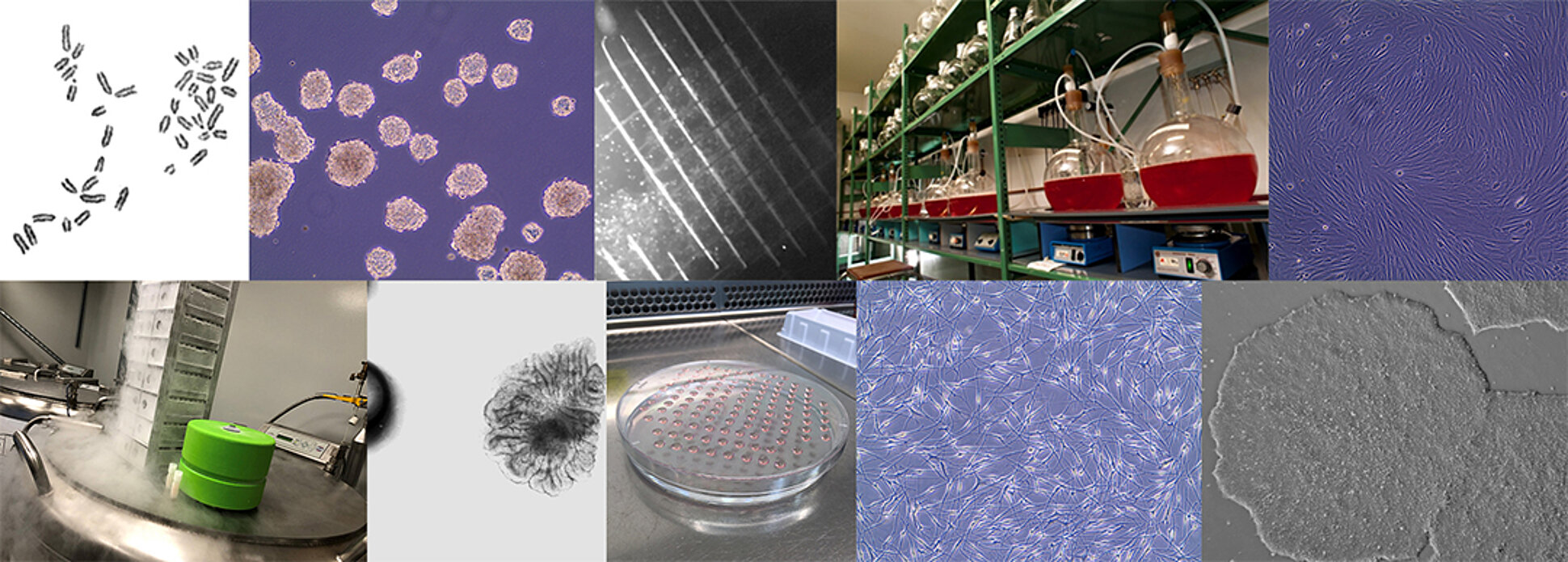
PluriCell East maintains a referenced collection of more than 2,400 human and animal cell lines, including normal and tumor cell lines, as well as cell lines derived from patients with genetic diseases. The platform provides services including the culture and storage of primary cells and human and animal cell lines, large-scale suspension cell culture in volumes of up to 25 L, and the production and preparation of culture media. We also provide quality control services and testing of new culture conditions, for example when evaluating new FCS batches or culture media.
These activities rely on rigorous monitoring and management of cell cultures. Cell lines and cultures are registered in our database and are subject to continuous monitoring and traceability throughout their use. Established protocols and procedures are applied to the different stages of cell culture and handling to ensure reproducible practices, reliable project monitoring, and consistent quality of our services.
For more than 10 years, the platform has developed specific expertise in the culture, maintenance, and characterization of pluripotent stem cells, particularly human induced pluripotent stem cells (hiPSCs) and mouse embryonic stem cells (mESCs).
This expertise has been extended to CRISPR-Cas9-based genome editing of hiPSCs. Since the launch of this service in spring 2025, 7 hiPSC genome editing projects have already been completed, including knock-out (KO), knock-in (KI), and base editing approaches. The platform has also recently developed a somatic cell reprogramming service to generate hiPSCs.

The PluriCell East platform provides its expertise as well as scientific and technological support to meet users’ needs.
Cell Culture
- Culture and storage of primary cells and human and animal cell lines, including normal and patient-derived cells.
- Large-scale suspension cell culture, with volumes of up to 25 L.
- Production of LIF (Leukemia Inhibitory Factor).
- Production and preparation of customized culture media.
Pluripotent Stem Cells
- Culture, maintenance, and storage of human induced pluripotent stem cells (hiPSCs) and mouse embryonic stem cells (mESCs).
- CRISPR-Cas9-based genome editing of hiPSCs, including KO, KI, and base editing approaches.
- Reprogramming of somatic cells into hiPSCs.NEW
- Training of users in hiPSCs culture.
- Access to dedicated BSL-2 laboratories for hiPSCs culture.
Cell Culture Quality Control
PluriCell East provides a range of quality control and cell culture characterization services, including:
- Thawing tests
- Mycoplasma detection
- hiPSC characterization
- Karyotyping and chromosome counting
Optimization and Development of Culture Conditions
The platform provides cell culture condition optimization and testing of new products or methods, including materials, culture media, serum batches, and optimization of cell culture techniques.
Project Support
PluriCell East also provides technical and scientific support to researchers throughout their projects.
BSL-2 Laboratories available to users
- 2 BSL-2 laboratories dedicated to hiPSCs culture.
- 1 BSL-2 laboratory dedicated to virus handling.
New
- Somatic Cell Reprogramming into hiPSCs
PluriCell East has developed a new somatic cell reprogramming service for the generation of human induced pluripotent stem cells (hiPSCs).
A first pilot project was carried out using two fibroblast cultures, enabling the platform to establish and validate the experimental conditions required to implement this new service.
120 m² cell culture laboratories (L1 et L2)
- 9 Biological Safety Cabinets HERASAFE KS12 et KS15
- 12 Incubators CO2 Panasonic
- 3 inverted Zeiss Microscopes
- 2 observation system Lynx Stereo Vision Engineering for hiPSC culture
- 1 NucleoCounter NC-202 ChemoMetec
- 1 room at 37°C for large scale suspension cells culture
2 Laboratories L2 dedicated to hiPSC culture:
- 7 Biological Safety Cabinets HERASAFE KS12 et KS15
- 6 incubators CO2 Panasonic
- 1 incubator tri-gas for culture in hypoxia
- 4 Leica observation systems
- 2 Lynx observation system Stereo Vision Engineering
- 1 inverted Microscopes whose 1 fluorescence microscope with camera
For any request to the PluriCell East Platform, please contact us at :
pluricell-east@igbmc.fr
The PluriCell East platform is involved in several regional, national and European networks :
- CoRTeCS (https://cortecs.unistra.fr/)
- CorEuStem (https://coreustem.eu/)
- Cancéropole Grand Est (https://www.canceropole-est.org/)
- GDR organoïdes (https://gdr-organoides.cnrs.fr/)

Publications
2021
Article in a journal
Single cell transcriptomics reveal trans-differentiation of pancreatic beta cells following inactivation of the TFIID subunit Taf4
- Thomas Kleiber
- Guillaume Davidson
- Gabrielle Mengus
- Igor Martianov
- Irwin Davidson
Cell Death and Disease ; Volume: 12 ; Page: 790
Article in a journal
The related coactivator complexes SAGA and ATAC control embryonic stem cell self-renewal through acetyltransferase-independent mechanisms
- Veronique Fischer
- Damien Plassard
- Tao Ye
- Bernardo Reina-San-Martin
- Matthieu Stierle
- Laszlo Tora
- Didier Devys
Cell Reports ; Volume: 36 ; Page: 109598
2020
Article in a journal
TBPL2/TFIIA complex establishes the maternal transcriptome through oocyte-specific promoter usage
- Changwei Yu
- Nevena Cvetesic
- Vincent Hisler
- Kapil Gupta
- Tao Ye
- Emese Gazdag
- Luc Negroni
- Petra Hajkova
- Imre Berger
- Boris Lenhard
- Ferenc Müller
- Stéphane D Vincent
- László Tora
Nature Communications ; Volume: 11 ; Page: 6439
Article in a journal
FFAT motif phosphorylation controls formation and lipid transfer function of inter‐organelle contacts
- Thomas Di Mattia
- Arthur Martinet
- Souade Ikhlef
- Alastair G Mcewen
- Yves Nominé
- Corinne Wendling
- Pierre Poussin‐courmontagne
- Laetitia Voilquin
- Pascal Eberling
- Frank Ruffenach
- Jean Cavarelli
- John Slee
- Timothy P Levine
- Guillaume Drin
- Catherine Tomasetto
- Fabien Alpy
EMBO Journal ; Volume: 39
Article in a journal
Deubiquitylase UCHL3 regulates bi‐orientation and segregation of chromosomes during mitosis
- Katerina Jerabkova
- Yongrong Liao
- Charlotte Kleiss
- Sadek Fournane
- Matej Durik
- Arantxa Agote‐arán
- Laurent Brino
- Radislav Sedlacek
- Izabela Sumara
FASEB Journal ; Volume: 34 ; Page: 12751 - 12767
Article in a journal
Spatial control of nucleoporin condensation by fragile X‐related proteins
- Arantxa Agote‐aran
- Stephane Schmucker
- Katerina Jerabkova
- Inès Jmel Boyer
- Alessandro Berto
- Laura Pacini
- Paolo Ronchi
- Charlotte Kleiss
- Laurent Guerard
- Yannick Schwab
- Hervé Moine
- Jean‐louis Mandel
- Sebastien Jacquemont
- Claudia Bagni
- Izabela Sumara
EMBO Journal ; Volume: 39
Article in a journal
Defective transcription of ATF3 responsive genes, a marker for Cockayne Syndrome
- Alexey Epanchintsev
- Marc-Alexander Rauschendorf
- Federico Costanzo
- Nadège Calmels
- Cathy Obringer
- Alain Sarasin
- Frédéric Coin
- Vincent Laugel
- Jean-Marc Egly
Scientific Reports ; Volume: 10 ; Page: 1105
Article in a journal
Molecular determinants of MED1 interaction with the DNA bound VDR–RXR heterodimer
- Y Belorusova Anna
- Maxime Bourguet
- Steve Hessmann
- Sandra Chalhoub
- Bruno Kieffer
- Sarah Cianférani
- Natacha Rochel
Nucleic Acids Research
Article in a journal
Correction: Ikaros antagonizes DNA binding by STAT5 in pre-B cells
- Beate Heizmann
- Stéphanie Le Gras
- Célestine Simand
- Patricia Marchal
- Susan Chan
- Philippe Kastner
PLoS ONE ; Volume: 15 ; Page: e0242211
Article in a journal
Cytosolic sequestration of the vitamin D receptor as a therapeutic option for vitamin D-induced hypercalcemia
- Daniela Rovito
- Anna y Belorusova
- Sandra Chalhoub
- Anna-Isavella Rerra
- Elvire Guiot
- Arnaud Molin
- Agnès Linglart
- Natacha Rochel
- Gilles Laverny
- Daniel Metzger
Nature Communications ; Volume: 11 ; Page: 6249