
PluriCell East
PluriCell East

With more than 30 years of expertise in cell culture, the PluriCell East platform provides scientific and technological services and support tailored to the needs of academic and private research communities, both in France and internationally.
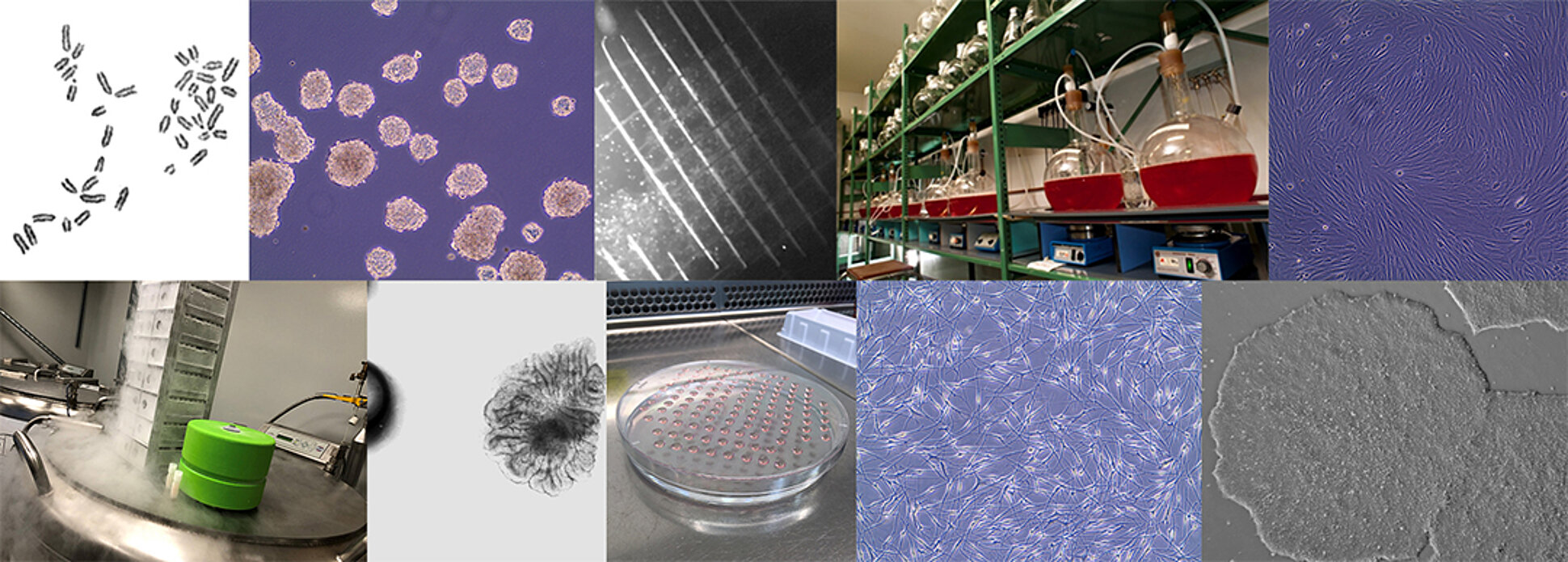
PluriCell East maintains a referenced collection of more than 2,400 human and animal cell lines, including normal and tumor cell lines, as well as cell lines derived from patients with genetic diseases. The platform provides services including the culture and storage of primary cells and human and animal cell lines, large-scale suspension cell culture in volumes of up to 25 L, and the production and preparation of culture media. We also provide quality control services and testing of new culture conditions, for example when evaluating new FCS batches or culture media.
These activities rely on rigorous monitoring and management of cell cultures. Cell lines and cultures are registered in our database and are subject to continuous monitoring and traceability throughout their use. Established protocols and procedures are applied to the different stages of cell culture and handling to ensure reproducible practices, reliable project monitoring, and consistent quality of our services.
For more than 10 years, the platform has developed specific expertise in the culture, maintenance, and characterization of pluripotent stem cells, particularly human induced pluripotent stem cells (hiPSCs) and mouse embryonic stem cells (mESCs).
This expertise has been extended to CRISPR-Cas9-based genome editing of hiPSCs. Since the launch of this service in spring 2025, 7 hiPSC genome editing projects have already been completed, including knock-out (KO), knock-in (KI), and base editing approaches. The platform has also recently developed a somatic cell reprogramming service to generate hiPSCs.

The PluriCell East platform provides its expertise as well as scientific and technological support to meet users’ needs.
Cell Culture
- Culture and storage of primary cells and human and animal cell lines, including normal and patient-derived cells.
- Large-scale suspension cell culture, with volumes of up to 25 L.
- Production of LIF (Leukemia Inhibitory Factor).
- Production and preparation of customized culture media.
Pluripotent Stem Cells
- Culture, maintenance, and storage of human induced pluripotent stem cells (hiPSCs) and mouse embryonic stem cells (mESCs).
- CRISPR-Cas9-based genome editing of hiPSCs, including KO, KI, and base editing approaches.
- Reprogramming of somatic cells into hiPSCs.NEW
- Training of users in hiPSCs culture.
- Access to dedicated BSL-2 laboratories for hiPSCs culture.
Cell Culture Quality Control
PluriCell East provides a range of quality control and cell culture characterization services, including:
- Thawing tests
- Mycoplasma detection
- hiPSC characterization
- Karyotyping and chromosome counting
Optimization and Development of Culture Conditions
The platform provides cell culture condition optimization and testing of new products or methods, including materials, culture media, serum batches, and optimization of cell culture techniques.
Project Support
PluriCell East also provides technical and scientific support to researchers throughout their projects.
BSL-2 Laboratories available to users
- 2 BSL-2 laboratories dedicated to hiPSCs culture.
- 1 BSL-2 laboratory dedicated to virus handling.
New
- Somatic Cell Reprogramming into hiPSCs
PluriCell East has developed a new somatic cell reprogramming service for the generation of human induced pluripotent stem cells (hiPSCs).
A first pilot project was carried out using two fibroblast cultures, enabling the platform to establish and validate the experimental conditions required to implement this new service.
120 m² cell culture laboratories (L1 et L2)
- 9 Biological Safety Cabinets HERASAFE KS12 et KS15
- 12 Incubators CO2 Panasonic
- 3 inverted Zeiss Microscopes
- 2 observation system Lynx Stereo Vision Engineering for hiPSC culture
- 1 NucleoCounter NC-202 ChemoMetec
- 1 room at 37°C for large scale suspension cells culture
2 Laboratories L2 dedicated to hiPSC culture:
- 7 Biological Safety Cabinets HERASAFE KS12 et KS15
- 6 incubators CO2 Panasonic
- 1 incubator tri-gas for culture in hypoxia
- 4 Leica observation systems
- 2 Lynx observation system Stereo Vision Engineering
- 1 inverted Microscopes whose 1 fluorescence microscope with camera
For any request to the PluriCell East Platform, please contact us at :
pluricell-east@igbmc.fr
The PluriCell East platform is involved in several regional, national and European networks :
- CoRTeCS (https://cortecs.unistra.fr/)
- CorEuStem (https://coreustem.eu/)
- Cancéropole Grand Est (https://www.canceropole-est.org/)
- GDR organoïdes (https://gdr-organoides.cnrs.fr/)

Publications
2021
Article in a journal
Targeting the RHOA pathway improves learning and memory in adult Kctd13 and 16p11.2 deletion mouse models
- Sandra Martin Lorenzo
- Valérie Nalesso
- Claire Chevalier
- Marie-Christine Birling
- Yann Hérault
Molecular Autism ; Volume: 12
Article in a journal
Extensive NEUROG3 occupancy in the human pancreatic endocrine gene regulatory network
- Valérie Schreiber
- Reuben Mercier
- Sara Jiménez
- Tao Ye
- Emmanuel García-Sánchez
- Annabelle Klein
- Aline Meunier
- Sabitri Ghimire
- Catherine Birck
- Bernard Jost
- Kristian Honnens de Lichtenberg
- Christian Honoré
- Palle Serup
- Gérard Gradwohl
Molecular metabolism ; Volume: 53 ; Page: 101313
Article in a journal
TAF8 regions important for TFIID lobe B assembly or for TAF2 interactions are required for embryonic stem cell survival
- Elisabeth Scheer
- Jie Luo
- Andrea Bernardini
- Frank Ruffenach
- Jean-Marie Garnier
- Isabelle Kolb-Cheynel
- Kapil Gupta
- Imre Berger
- Jeff Ranish
- László Tora
Journal of Biological Chemistry ; Volume: 297
Article in a journal
Ikaros deficiency is associated with aggressive BCR-ABL1 B cell precursor acute lymphoblastic leukemia independent of the lineage and developmental origin
- Célestine Simand
- Céline Keime
- Aurélie Caye
- Chloé Arfeuille
- Marie Passet
- Rathana Kim
- Helene Cavé
- Emmanuelle Clappier
- Philippe Kastner
- Susan Chan
- Beate Heizmann
Haematologica ; Volume: 107 ; Page: 316-320
Article in a journal
CDK7 and MITF repress a transcription program involved in survival and drug tolerance in melanoma
- Pietro Berico
- Max Cigrang
- Guillaume Davidson
- Cathy Braun
- Jeremy Sandoz
- Stephanie Legras
- Bujamin Hektor Vokshi
- Nevena Slovic
- François Peyresaubes
- Carlos Mario Genes Robles
- Jean‐marc Egly
- Emmanuel Compe
- Irwin Davidson
- Frédéric Coin
EMBO Reports ; Volume: 22 ; Page: e51683
SUPT3H-less SAGA coactivator can assemble and function without significantly perturbing RNA polymerase II transcription in mammalian cells
- Veronique Fischer
- Elisabeth Scheer
- Elisabeth Lata
- Bastian Morlet
- Damien Plassard
- Stéphane D. Vincent
- Dominique Helmlinger
- Didier Devys
- László Tora
Cold Spring Harbor Laboratory
Article in a journal
Myod1 and GR coordinate myofiber-specific transcriptional enhancers
- Daniela Rovito
- Anna-Isavella Rerra
- Vanessa Ueberschlag-Pitiot
- Shilpy Joshi
- Nezih Karasu
- Vanessa Dacleu-Siewe
- Khalil Ben Rayana
- Kamar Ghaibour
- Maxime Parisotto
- Arnaud Ferry
- Scott A Jelinsky
- Gilles Laverny
- Bruno P Klaholz
- Tom Sexton
- Isabelle M L Billas
- Delphine Duteil
- Daniel Metzger
Nucleic Acids Research ; Volume: 49 ; Page: 4472 - 4492
Article in a journal
Citrullination of pyruvate kinase M2 by PADI1 and PADI3 regulates glycolysis and cancer cell proliferation
- Sébastien Coassolo
- Guillaume Davidson
- Luc Negroni
- Giovanni Gambi
- Sylvain Daujat
- Christophe Romier
- Irwin Davidson
Nature Communications ; Volume: 12
Article in a journal
Histone H2Bub1 deubiquitylation is essential for mouse development, but does not regulate global RNA polymerase II transcription
- Fang Wang
- Farrah El-Saafin
- Tao Ye
- Matthieu Stierle
- Luc Negroni
- Matej Durik
- Veronique Fischer
- Didier Devys
- Stéphane D Vincent
- László Tora
Cell Death and Differentiation ; Volume: 28 ; Page: 2385-2403
Article in a journal
A PKD-MFF signaling axis couples mitochondrial fission to mitotic progression
- Evanthia Pangou
- Olga Bielska
- Lucile Guerber
- Stephane Schmucker
- Arantxa Agote-Arán
- Taozhi Ye
- Yongrong Liao
- Marta Puig-Gamez
- Erwan Grandgirard
- Charlotte Kleiss
- Yansheng Liu
- Emmanuel Compe
- Zhirong Zhang
- Ruedi Aebersold
- Romeo Ricci
- Izabela Sumara
Cell Reports ; Volume: 35 ; Page: 109129