
MOLECULAR BASIS OF THE INITIATION OF PROTEIN SYNTHESIS IN HUMANS
To produce a protein, the ribosome must identify where to start reading the messenger RNA. A sequence located around this starting point, called the Kozak sequence, helps it identify this site.
In a study published in Nature Communications, scientists reveal how the human ribosome recognizes this sequence, thereby promoting the initiation of protein synthesis.
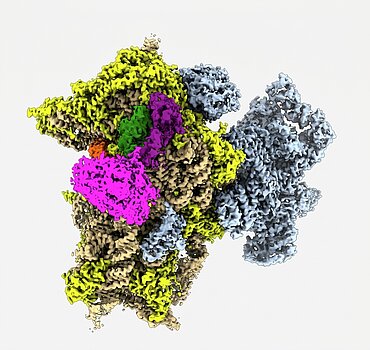
The Kozak sequence: known for 40 years, but how does it work?
Protein synthesis is a tightly regulated molecular process in all species. To produce a protein, the ribosome reads the instructions carried by a messenger RNA (mRNA). Reading generally begins at a group of three nucleotides called the initiation codon, or AUG. But recognizing AUG is not always enough: the nucleotides surrounding it also influence the efficiency of initiation.
Described more than forty years ago, the Kozak sequence refers to a favorable nucleotide context around this codon. Two positions play an important role: position −3, before AUG, and position +4, just after it. The presence of a purine at these positions—one of the two families of RNA bases, comprising adenine and guanine—promotes translation initiation. However, how the ribosome distinguishes between these bases remained poorly understood.
A cavity in the ribosome enables recognition of the Kozak sequence
In an article published in Nature Communications, the scientists used high-resolution cryo-electron microscopy to study several human complexes captured just before the start of protein synthesis. This method makes it possible to reconstruct their structures at very high resolution. By comparing mRNAs that differ at positions −3 and +4, the team was able to observe how these changes alter their interactions with the ribosome.
Three nucleotides of the mRNA upstream of the AUG codon fit into a cavity formed by the RNA of the ribosome’s small subunit. The scientists named it the “G-clamp” because two guanines help frame it. This cavity positions nucleotide −3 close to eIF2α, a protein involved in translation initiation. When a purine (an A or G nucleotide) occupies this position, it can form an interaction that stabilizes the complex. A pyrimidine (a U or C nucleotide), which belongs to the other family of nucleotides, cannot form the same interaction.
Molecular rearrangements stabilize the messenger RNA
At position +4, recognition relies on a different mechanism. When a purine is present, the mRNA, ribosomal RNA and initiation factor eIF1A adjust their positions relative to one another. Some of their bases then stack on top of one another, like the elements of a pile, stabilizing the region of the mRNA located after AUG. This arrangement does not form in the same way when a pyrimidine occupies position +4.
The study thus shows that ribosomal RNA directly contributes to the recognition of the Kozak sequence, but through a mechanism different from that known in bacteria. In bacteria, a sequence in the messenger RNA can pair with a complementary sequence in ribosomal RNA, helping position the ribosome at the starting point of translation. In eukaryotes, recognition of the Kozak sequence relies on base stacking and adjustments in the shape of the molecules. Ribosomal RNA provides the framework for these interactions, while the factors eIF2α and eIF1A provide additional selectivity.
These findings shed light on a fundamental step in the regulation of protein production, with implications for understanding certain diseases and producing therapeutic proteins.
_____________________________________________________________________________________________________________
CNRS BIOLOGIE - 20 october 2026 - https://www.insb.cnrs.fr/fr/cnrsinfo/base-moleculaire-du-demarrage-de-la-synthese-des-proteines-chez-les-humains
Find out more:von Loeffelholz O, Barchet C, Holvec S, Abou Ramadan A, Protuc C, Maglott-Roth A, de Silva SNT, Hazemann I, Klaholz BP. Translation initiation by the Kozak mRNA sequence is based on a conformational readout on the ribosome. Nat Commun. 2026 Jul 8;17(1):8467. doi: 10.1038/s41467-026-73969-2. PMID: 42420270; PMCID: PMC13478227.
Contact :
Bruno Klaholz
CNRS Research Director
klaholz@igbmc.fr