
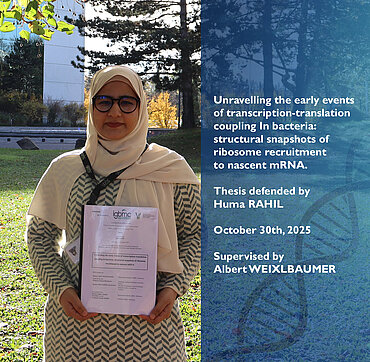
Congratulations to Huma RAHIL on earning their PhD!
Her work, supervised by Albert WEIXLBAUMER
is entitled “Unravelling the early events of transcription-translation coupling in bacteria: structural snapshots of ribosome recruitment to nascent mRNA”.
- Summary of her research work:
My PhD work focused on elucidating the molecular mechanisms that coordinate transcription and translation in bacteria. Although translation is known to influence transcription, this research investigated the reciprocal process, how transcription can promote translation initiation.
Using cryo-electron microscopy, the study uncovered structural pathways by which nascent mRNA emerging from RNA polymerase (RNAP) is delivered to the 30S ribosomal subunit. The findings revealed two distinct mechanisms of mRNA recruitment: (1) an RNAP assisted handoff in which ribosomal protein bS1 guides and stabilizes early mRNA interactions with the 30S subunit, and (2) a direct RNAP-ribosome coupling pathway mediated by transcription factor NusG. The work further reveals previously uncharacterized intermediates in translation initiation, including an inverted Shine-Dalgarno/anti-Shine-Dalgarno orientation and early mRNA delivery states that precede pre-initiation complex formation. Furthermore, I resolved the full architecture of bS1 and showed its central role in delivering mRNA via the 30S exit channel, a mechanism not described before.
The second objective of my thesis focused on 30S ribosome activation. I characterized the 30S-RNAP complex in the presence of initiation factors, initiator tRNA, and NusG, which provided novel insights into translation initiation and the role of initiation factors. Our results show that initiation factors actively modulate 30S conformation, promoting ribosome activation. These findings advance our understanding of how initiation factors orchestrate early translation events.
The third objective aimed to investigate how trailing ribosomes release RNAP from a hairpin-stabilized paused state. The project began by structurally characterizing the paused elongation complex of E. coli RNAP at the well-characterized his pause site. The complex was prepared co-transcriptionally and I successfully captured an open clamp hairpin-paused complex, providing mechanistic insights into conformational rearrangements of RNAP during pausing at class I pause sites.
Overall, this research provides new structural insight into how transcription and translation are physically and functionally coordinated within bacterial cells, contributing to a deeper understanding of gene expression regulation.
- Skills acquired at the IGBMC:
During my PhD, I have learned how to think and work as an independent scientist. I developed deep expertise in structural biology, cryo-electron microscopy, and the molecular mechanisms governing gene expression. These years taught me how to design and execute complex experiments, interpret large and challenging datasets, and connect structural observations to biological function.
- Life at the IGBMC:
When I arrived in France, I was terrified. Everything felt unfamiliar the culture, the language, the way of life was all new to me. I was worried that my identity, my religion, and my hijab would set me apart in a way I couldn’t overcome. But the day I walked into IGBMC, something inside me shifted.
This institute didn’t just welcome me, it embraced me. I discovered a truly international scientific community where I was evaluated for my skills, my dedication, and my talent never for my religious identity or ethnicity. Coming from a traditional and conservative background where women’s education is rare, even unthinkable for many, studying abroad let alone pursuing a PhD once felt impossible.
IGBMC not only gave me the chance to pursue higher education, it gave an underprivileged woman the opportunity to dream big. It opened a door I never imagined would exist for someone like me.
I sincerely thank IGBMC for giving me the opportunity to proudly call myself the first woman in my family to attend university and to earn a degree as meaningful as a PhD.
This experience has changed my life forever.
- Funding and partners:
My PhD was funded through the IMCBio doctoral program and supported by the Fondation pour la Recherche Médicale (FRM) 4th-year fellowship.
- Future projects:
I plan to pursue a postdoctoral position and build a career in academia, contributing to research while mentoring and inspiring the next generation of scientists, especially women in science.