
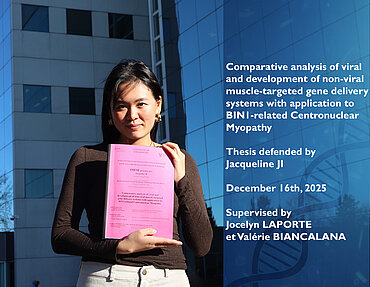
Congratulations to Jacqueline JI on earning their PhD!
Her work, supervised by Jocelyn LAPORTE and Valérie BIANCALANA
is entitled :“Comparative analysis of viral and development of non-viral muscle targeted gene delivery systems with application to BIN1-related Centronuclear Myopathy".
- Summary of her research work:
Centronuclear myopathies (CNMs) are rare genetic muscle diseases that affect the structure and function of skeletal muscle. This thesis aimed to develop gene delivery systems specifically targeted to skeletal muscle using viral or non-viral approaches, with a particular focus on BIN1-related CNM (CNM-BIN1). Comparative analysis of myotropic AAVs derived from AAV9 identified MyoAAV4A as the most effective vector for transducing muscle and heart while de-targeting the liver.
In parallel, lipid nanoparticles functionalized with the MyomP1 peptide (MyomP1-LNPs) were developed to achieve active muscle targeting and reduce liver uptake, thus providing a promising non-viral alternative. The use of the optimized MyoAAV4A vector for BIN1 gene replacement therapy restored muscle structure and function in CNM-BIN1 mice, even after disease onset, by correcting key features of CNM such as muscle weakness and atrophy through the restoration of the T-tubule network and proteins involved in excitation-contraction coupling.
Overall, this work proposes effective viral and non-viral platforms for targeted muscle gene therapy and opens new therapeutic perspectives for BIN1-related CNMs and, more broadly, for other genetic muscle diseases.
- Skills acquired at the IGBMC:
The PhD was an extremely formative experience, both professionally and personally.
From a professional perspective, it taught me how to structure and communicate my research clearly, as well as how to design, manage, and independently conduct projects. On a personal level, the PhD was a profound test of my patience and taught me to better manage the frustrations inherent to negative results, which are an integral part of the scientific process.
Finally, before starting my PhD, my background as a pharmacist had led me to view translational medicine in a rather binary way, in terms of success or failure. This research experience allowed me to develop a more nuanced perspective and a more critical and balanced approach, particularly when assessing the benefit-risk balance.
- Life at the IGBMC:
The large number of available platforms significantly accelerates research projects. The availability of an on-site animal facility also facilitates the implementation of in vivo studies. The large number of highly skilled scientists provides access to valuable advice and expertise. Finally, the numerous seminars organized on a wide range of scientific topics promote scientific exchange and exposure to new areas of research.
- Collaborations:
Nicolas ANTON, CRBS: Synthèse de nanoparticules lipidiques.
- Funding and partners:
AFM-Telethon
- Future projects:
In 2–5 years: Obtain a research scientist position.