
Intracellular trafficking, signalling and neurodegeneration
Intracellular trafficking, signalling and neurodegeneration

Communication between neurons is essential for brain function and relies on the release of neurotransmitters and trophic factors at synapses. Before their release, these molecules are transported along axons in vesicles propelled by molecular motors moving on microtubules. This transport is therefore critical for neuronal communication and the maintenance of neuronal circuits.
In Huntington’s disease (HD), a mutation in the huntingtin (HTT) protein disrupts the transport of various organelles, including those carrying the trophic factor BDNF, synaptic vesicle precursors, and signaling endosomes. These transport defects contribute to the dysfunction and death of neurons connecting the cortex and striatum, resulting in impaired synaptic transmission.
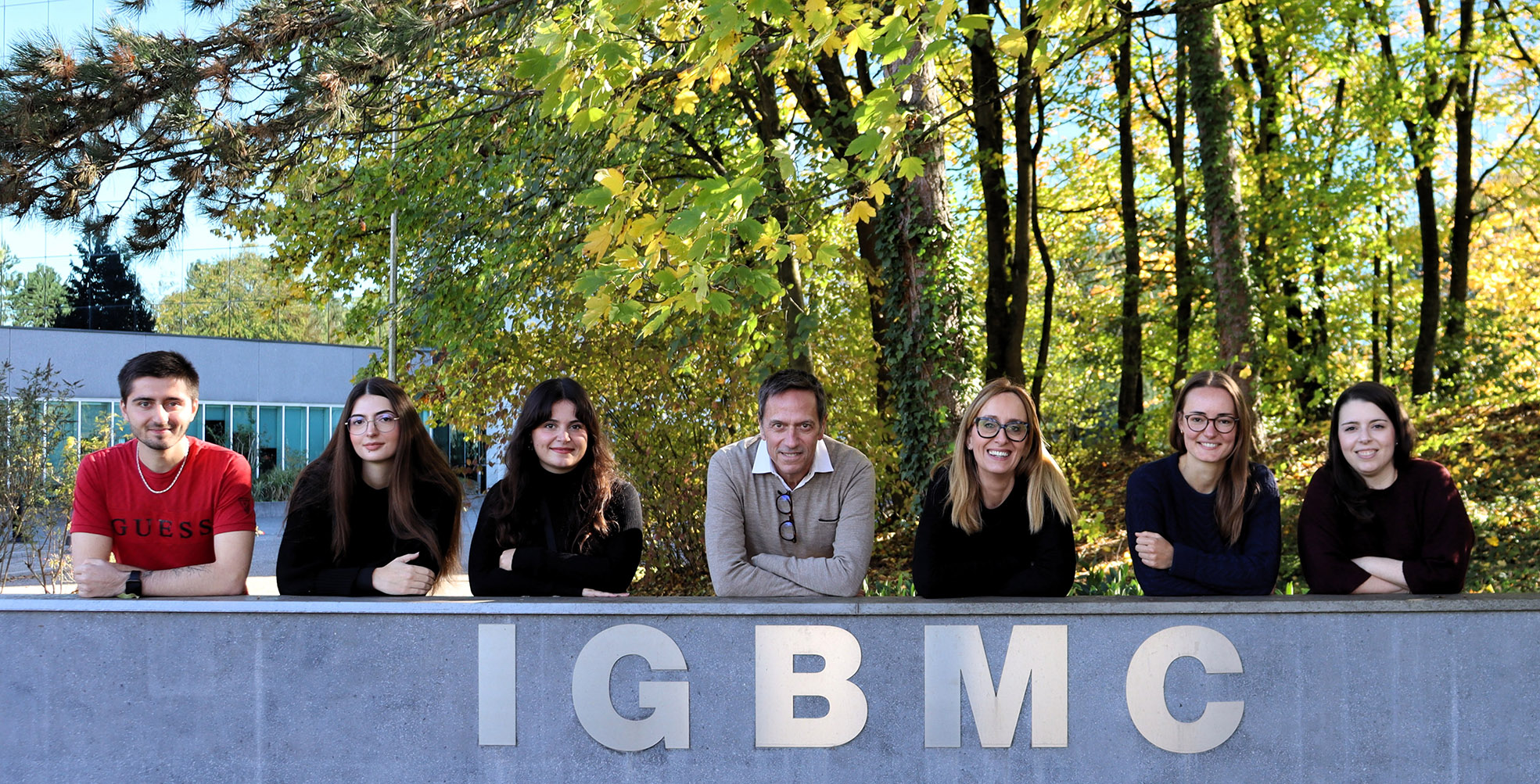
from left to right: Oscar Cosson, Ema Blondel, Barbara Nicolas, Frédéric Saudou, Chiara Scaramuzzino, Claire Sèris, Marta Prieto.
Members
Researchers
PhD students
Engineers
Current projects
Our laboratory aims to elucidate the mechanisms by which HTT regulates fast axonal transport, understand how this transport is altered in HD, and identify and develop potential therapeutic targets.
- We discovered that HTT transports not only molecules but also translational machinery associated with organelles. We aim to characterize the signals transported over long distances in axons and dendrites to maintain neuronal circuits and determine how these signals are altered in HD.
- We found that HTT couples the energy produced on vesicles to its consumption by molecular motors that propel these vesicles along axons. We aim to understand the relationship between neuronal activity, energy supply, and axonal transport in healthy conditions and in HD.
To achieve these aims, we devote substantial effort to developing microfluidic devices that reconstruct physiologically relevant, functional neuronal networks in vitro. These devices are compatible with high-resolution video recording of axonal trafficking, and we combine these approaches with in vivo studies in relevant animal models.
Collaborations and networks
- Sandrine Humbert, ICM Paris
- Juliette Godin, IGBMC Strasbourg
- Manuela Basso, CIBIO Trento
Funding and partners
- ANR
- ERC AdG
- Hereditary disease foundation (HDF)
- Fondation pour la Recherche Médicale (équipe FRM)
- Fondation pour la Recherche sur le Cerveau (FRC)
- Association Huntington France (AHF)
Awards and recognitions
2023 : Chiara Scaramuzzino - Nancy S. Wexler Young Investigator Prize - Hereditary Disease Foundation
Resources
PUBLICATIONS
2026
Saliba M, Saudou F, Scaramuzzino C. “Huntingtin, signaling endosomes and neuronal survival in health and Huntington disease”. Journal of Huntington Disease
2023
- Mc Cluskey M, Dubouchaud H, Nicot AS, Saudou F. “A vesicular Warburg effect: Aerobic glycolysis occurs on axonal vesicles for local NAD+ recycling and transport”. Traffic
- Vitet H, Bruyere J, Xu H, Brocard J, Abada YS, Delatoru B, Scaramuzzino C#, Venance L, Saudou F#. “Huntingtin-KIF1A-mediated axonal transport of synaptic vesicle precursors influences synaptic transmission and motor skill learning in mice”. eLife # corresponding authors
2022
- Kim H, Lenoir S, Helfricht A, Jung T, Karneva ZK, Lee Y, Beumer W, van der Horst GB, Anthonijsz H, Buil LC, van der Ham F, Platenburg GJ, Purhonen P, Hebert* H, Humbert* S, Saudou* F, Klein* P, Song* JJ. “A pathogenic proteolysis-resistant huntingtin isoform induced by an antisense oligonucleotide maintains huntingtin function”. JCI Insight (2022) *co-corresponding authors.
- Scaramuzzino C, Cuoc M.E, Pla P, Humbert S, Saudou F. “Endosomes can respond autonomously to local calcium concentrations to direct long-range retrograde neurotrophin signaling”. Science Advances.
- Lenoir S*, Lahaye R*, Vitet H, Scaramuzzino C, Virlogeux A, Capellano L, Genoux A, Gershoni-Emek N, Geva M, Hayden RM, Saudou F. “Pridopidine rescues BDNF/TrkB trafficking dynamics and synapse homeostasis in a Huntington disease brain-on-a-chip model”. Neurobiology of Disease * first authors
2021
- Migazzi A*, Scaramuzzino C*, Anderson E, Tripathy D, Hernández I.H, Grant R, Roccuzzo M, Tosatto L, Virlogeux A, Zuccato C, Caricasole A, Ratovitski T, Ross C.A, Pandey U, Lucas J.J, Saudou F, Pennuto M, Basso M. “Huntingtin-mediated axonal transport requires arginine methylation by PRMT6”. Cell Reports *first authors.
- Virlogeux V*, Scaramuzzino C*, Lenoir S, Carpentier R, Louessard M, Genoux A, Lino P, Hinckelmann M.V, Perrier A.L, Humbert S and Saudou F. “Increasing brain palmitoylation rescues behavior and neuropathology in Huntington disease mice”. Science Advances *first authors
2020
- Bruyère J, Abada YS, Vitet HM, Fontaine G, Deloulme JC, Cës A, Denarier E, Pernet-Gallay K, Andrieux A, Sandrine Humbert S, Marie-Claude Potier MC, BenoÎt Delatour B and Saudou F. “Presynaptic APP levels and synaptic homeostasis are regulated by Akt phosphorylation of Huntingtin”. eLife
- Vitet H, Brandt V, and Saudou F. “Traffic signaling: new functions of huntingtin and axonal transport in neurological disease”. Curr Opin Neurobiol