
Differentiation and physiopathology of endocrine cells in the pancreas and intestine
Differentiation and physiopathology of endocrine cells in the pancreas and intestine

Our main goal is to decipher the transcriptional networks controlling the differentiation, function and maintenance of endocrine cells in the pancreas and intestine in normal and pathological conditions.
Future strategies for cell replacement therapies and regenerative medicine strongly depend on our knowledge of the detailed mechanisms that control the differentiation of multipotent stem cells into highly specialized cells. Along these lines of research, our goal is to understand how the diversity of pancreatic and intestinal endocrine cells is generated from stem/progenitor cells during embryogenesis towards adult life.
Pancreatic endocrine cells are clustered in islets embedded in the exocrine tissue. Islets contain five hormone producing cell-types, including insulin-secreting beta cells, which, in concert, control glucose homeostasis. Absolute or relative insulin-deficiency lead to diabetes. Intestinal endocrine cells, also called enteroendocrine cells (EECs), are very closely related to pancreatic islet cells with respect to their embryonic origin, differentiation programs and physiological roles in the control of energy homeostasis. EECs are rare cells found along the intestinal mucosa, they sense nutrients in the gut lumen and, in response, secrete a variety of hormones that act locally or at distance to regulate energy homeostasis via their control of intestinal absorption, food intake and insulin secretion. We showed previously that pancreatic and intestinal endocrine cells arise from progenitor cells expressing the pro-endocrine transcription factor Neurog3. In absence of Neurog3, islet cells and EECs do not form leading to neonatal diabetes and intestinal malabsorption in mice and human. Despite the identification of a few targets of Neurog3, the molecular mechanisms implementing Neurog3 endocrinogenic function are poorly understood.
We focus on the identification and study of novel effectors controlling endocrine sub-type specification and functional maturation. To tackle these questions, we use stem cell based human organoid culture systems and mouse models combined with gene editing and multi-omics approaches. We hope that our studies will contribute to the development of a cell-based therapy in diabetes, as well as to understand the mechanisms underlying the pathophysiology of islet and enteroendocrine hormone failures in human.
Members
Researchers
PhD students
Technicians
Funding and partners
The team was supported by founding from
- Novonordisk Foundation
- Agence National pour la Recherche (ANR)
- Fondation pour la Recherche Médicale (FRM)
- Novonordisk
- National Institute for Diabetes and Digestive and Kidney Disease (NIDDK)
- Société Francophone du Diabète (SFD)
- Juvenile Diabetes Research Foundation (JDRF)
- European Union (6th FP)
- Institut Benjamin Delessert
- Association Française des Diabétiques (AFD)
- Université de Strasbourg
- ARC
- INSERM-AVENIR
News
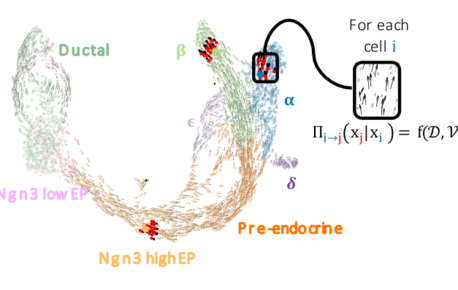
FateCompass: to identify and predict the decisive criteria of cell fate
Cell differentiation is a process regulated by gene expression through the action of transcription factors. Different transcription factors and…
Read more
Events
On
09/222026
Resources
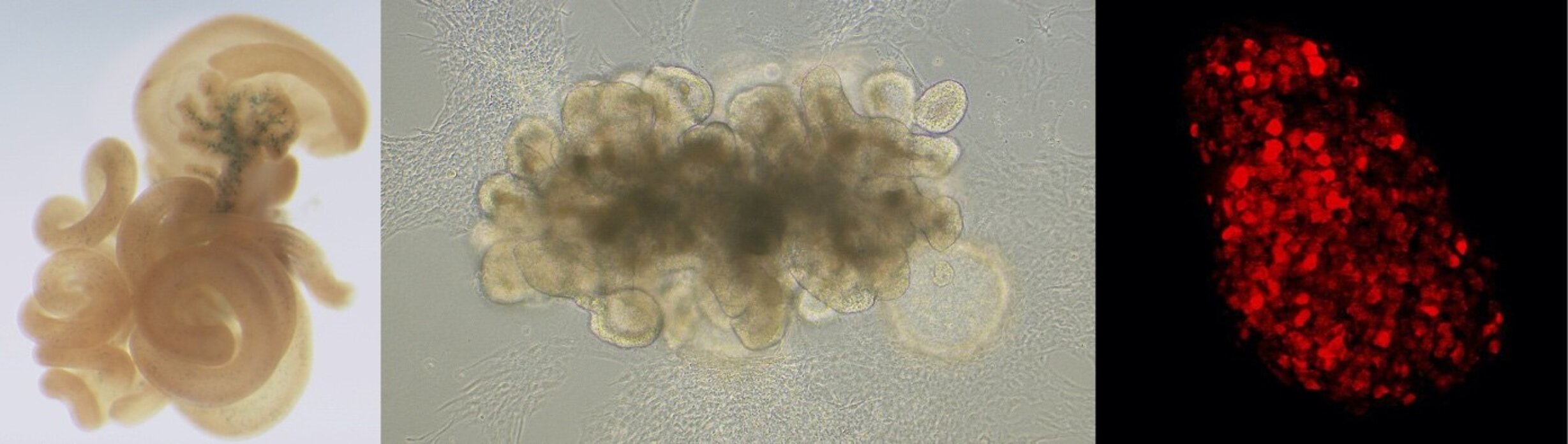
Human intestinal organoid. Enteroendocrine progenitors are expressing the transcription factor NEUROG3 (red).
https://seafile.igbmc.fr/f/80de9329f382470d80de/?dl=1
Publications
2018
Article in a journal
Integrin a6 loss promotes colitis-associated colorectal cancer. Response to: “Integrin a6 variants and colorectal cancer” by Beaulieu JF
- Adèle de Arcangelis
- Mathias Chamaillard
- Patricia Simon-Assmann
- Michel Labouesse
Gut ; Volume: 67 ; Page: 2227-2228
2017
Article in a journal
Dual role of pericyte alpha6beta1-integrin in tumour blood vessels
- Louise Reynolds
- Gabriela d'Amico
- Tanguy Lechertier
- Alexandros Papachristodoulou
- José Muñoz-Felix
- Adèle De Arcangelis
- Marianne Baker
- Bryan Serrels
- Kairbaan Hodivala-Dilke
Journal of Cell Science ; Volume: 130 ; Page: 1583-1595
Article in a journal
Integrin alpha6 maintains the structural integrity of the kidney collecting system
- Olga Viquez
- Eugenia Yazlovitskaya
- Tianxiang Tu
- Glenda Mernaugh
- Pablo Secades
- Karen Mckee
- Elizabeth Georges-Labouesse
- Adèle De Arcangelis
- Vito Quaranta
- Peter Yurchenco
- Leslie Gewin
- Arnoud Sonnenberg
- Ambra Pozzi
- Roy Zent
Matrix Biology ; Volume: 57-58 ; Page: 244-257
2016
Article in a journal
STAT3 modulates β-cell cycling in injured mouse pancreas and protects against DNA damage
- S de Groef
- D Renmans
- Y Cai
- G Leuckx
- S Roels
- W Staels
- G Gradwohl
- L Baeyens
- Y Heremans
- G Martens
- N de Leu
- M Sojoodi
- M van de Casteele
- H Heimberg
Cell Death and Disease ; Volume: 7 ; Page: e2272-e2272
Article in a journal
Expression and functional studies of the GDNF family receptor alpha 3 in the pancreas
- Laure Nivlet
- Joel Herrmann
- Delia Esteban Martin
- Aline Meunier
- Christophe Orvain
- Gérard Gradwohl
Journal of Molecular Endocrinology ; Volume: 56 ; Page: 77-90
2015
Article in a journal
Differentially Expressed MicroRNA-483 Confers Distinct Functions in Pancreatic β- and α-Cells
- Ramkumar Mohan
- Yiping Mao
- Shungang Zhang
- Yu-Wei Zhang
- Cheng-Ran Xu
- Gérard Gradwohl
- Xiaoqing Tang
Journal of Biological Chemistry ; Volume: 290 ; Page: 19955-19966
Chapter of the book
Discovery of the PARP Superfamily and Focus on the Lesser Exhibited But Not Lesser Talented Members
- Eléa Heberlé
- Jean-Christophe Amé
- Giuditta Fattori
- Françoise Dantzer
- Valerie Schreiber
PARP Inhibitors for Cancer Therapy ; Page: 15-46
Article in a journal
Pairing-up SOX to kick-start beta cell genesis
- Anne Grapin-Botton
- Philip Allan Seymour
- Gerard Gradwohl
Diabetologia ; Volume: 58 ; Page: 859-861
2014
Article in a journal
Tie2-dependent deletion of alpha6 integrin subunit in mice reduces tumor growth and angiogenesis
- Claire Bouvard
- Zacharie Segaoula
- Adèle de Arcangelis
- Isabelle Galy-Fauroux
- Laetitia Mauge
- Anne-Marie Fischer
- Elisabeth Georges-Labouesse
- Dominique Helley
International Journal of Oncology ; Volume: 45 ; Page: 2058-2064
Article in a journal
[The role of PARP2 in DNA repair].
- M M Kutuzov
- S N Khodyreva
- Valerie Schreiber
- O I Lavrik
Молекулярная биология / Molecular Biology ; Volume: 48