
Differentiation and physiopathology of endocrine cells in the pancreas and intestine
Differentiation and physiopathology of endocrine cells in the pancreas and intestine

Our main goal is to decipher the transcriptional networks controlling the differentiation, function and maintenance of endocrine cells in the pancreas and intestine in normal and pathological conditions.
Future strategies for cell replacement therapies and regenerative medicine strongly depend on our knowledge of the detailed mechanisms that control the differentiation of multipotent stem cells into highly specialized cells. Along these lines of research, our goal is to understand how the diversity of pancreatic and intestinal endocrine cells is generated from stem/progenitor cells during embryogenesis towards adult life.
Pancreatic endocrine cells are clustered in islets embedded in the exocrine tissue. Islets contain five hormone producing cell-types, including insulin-secreting beta cells, which, in concert, control glucose homeostasis. Absolute or relative insulin-deficiency lead to diabetes. Intestinal endocrine cells, also called enteroendocrine cells (EECs), are very closely related to pancreatic islet cells with respect to their embryonic origin, differentiation programs and physiological roles in the control of energy homeostasis. EECs are rare cells found along the intestinal mucosa, they sense nutrients in the gut lumen and, in response, secrete a variety of hormones that act locally or at distance to regulate energy homeostasis via their control of intestinal absorption, food intake and insulin secretion. We showed previously that pancreatic and intestinal endocrine cells arise from progenitor cells expressing the pro-endocrine transcription factor Neurog3. In absence of Neurog3, islet cells and EECs do not form leading to neonatal diabetes and intestinal malabsorption in mice and human. Despite the identification of a few targets of Neurog3, the molecular mechanisms implementing Neurog3 endocrinogenic function are poorly understood.
We focus on the identification and study of novel effectors controlling endocrine sub-type specification and functional maturation. To tackle these questions, we use stem cell based human organoid culture systems and mouse models combined with gene editing and multi-omics approaches. We hope that our studies will contribute to the development of a cell-based therapy in diabetes, as well as to understand the mechanisms underlying the pathophysiology of islet and enteroendocrine hormone failures in human.
Members
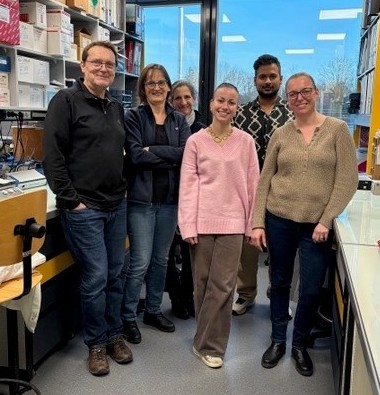
Researchers
PhD students
Technicians
Funding and partners
The team was supported by founding from
- Novonordisk Foundation
- Agence National pour la Recherche (ANR)
- Fondation pour la Recherche Médicale (FRM)
- Novonordisk
- National Institute for Diabetes and Digestive and Kidney Disease (NIDDK)
- Société Francophone du Diabète (SFD)
- Juvenile Diabetes Research Foundation (JDRF)
- European Union (6th FP)
- Institut Benjamin Delessert
- Association Française des Diabétiques (AFD)
- Université de Strasbourg
- ARC
- INSERM-AVENIR
News
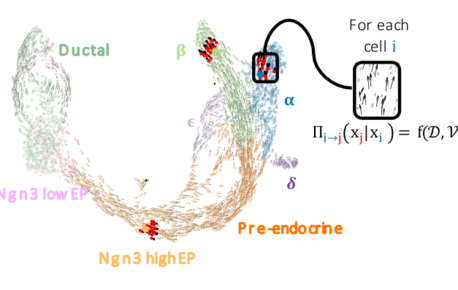
FateCompass: to identify and predict the decisive criteria of cell fate
Cell differentiation is a process regulated by gene expression through the action of transcription factors. Different transcription factors and…
Read more
Events
On
09/222026
Resources
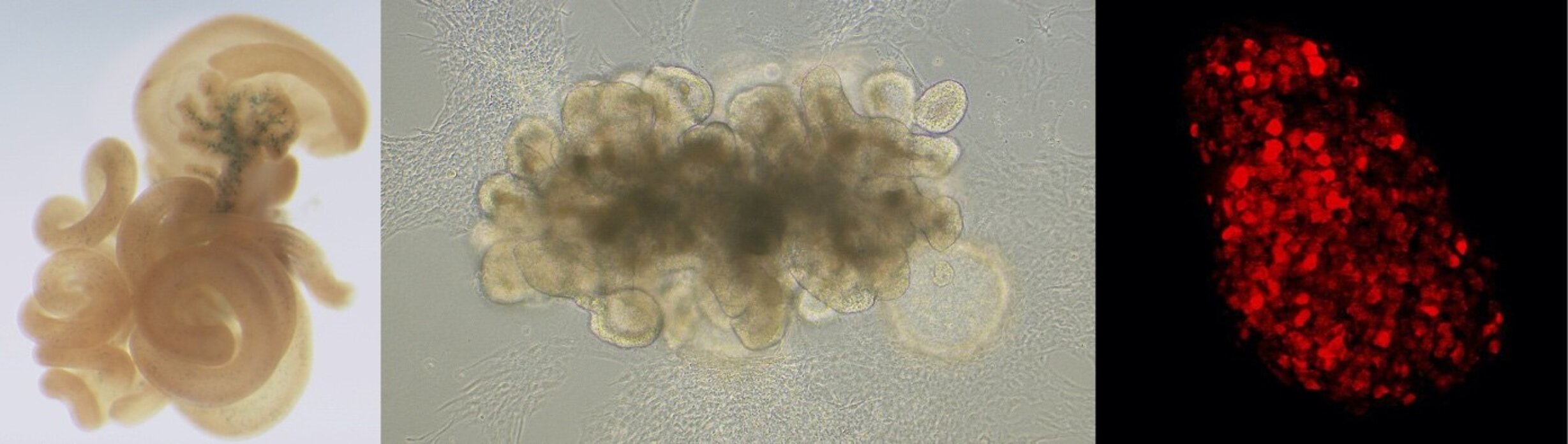
Human intestinal organoid. Enteroendocrine progenitors are expressing the transcription factor NEUROG3 (red).
https://seafile.igbmc.fr/f/80de9329f382470d80de/?dl=1
Publications
2021
Article in a journal
Reduced Neurog3 Gene Dosage Shifts Enteroendocrine Progenitor Towards Goblet Cell Lineage in the Mouse Intestine
- Hui Joyce Li
- Subir Ray
- Alper Kucukural
- Gerard Gradwohl
- Andrew Leiter
Cellular and Molecular Gastroenterology and Hepatology ; Volume: 11 ; Page: 433-448
2020
Article in a journal
Integrin α6 mediates the drug resistance of acute lymphoblastic B-cell leukemia
- Eun Ji Gang
- Hye Na Kim
- Yao-Te Hsieh
- Yongsheng Ruan
- Heather A. Ogana
- Solomon Lee
- Jennifer Pham
- Huimin Geng
- Eugene Park
- Lars Klemm
- Cheryl L. Willman
- William L. Carroll
- Steven D. Mittelman
- Etan Orgel
- Matthew J. Oberley
- Chintan Parekh
- Hisham Abdel-Azim
- Deepa Bhojwani
- Alan S. Wayne
- Adèle De Arcangelis
- ...
Blood ; Volume: 136 ; Page: 210-223
Article in a journal
Ascl1 is required to specify a subset of ventromedial hypothalamic neurons
- Shaghayegh Aslanpour
- Jessica M Rosin
- Anjali Balakrishnan
- Natalia Klenin
- Florence Blot
- Gerard Gradwohl
- Carol Schuurmans
- Deborah M Kurrasch
Development (Cambridge, England) ; Volume: 147 ; Page: dev180067
Article in a journal
Laminin-binding integrins are essential for the maintenance of functional mammary secretory epithelium in lactation
- Mathilde Romagnoli
- Laura Bresson
- Amandine Di-Cicco
- Maria Pérez-Lanzón
- Patricia Legoix
- Sylvain Baulande
- Pierre de La Grange
- Adèle de Arcangelis
- Elisabeth Georges-Labouesse
- Arnoud Sonnenberg
- Marie-Ange Deugnier
- Marina A Glukhova
- Marisa Martin Faraldo
Development (Cambridge, England) ; Volume: 147 ; Page: dev181552
2019
Article in a journal
Rfx6 promotes the differentiation of peptide-secreting enteroendocrine cells while repressing genetic programs controlling serotonin production
- Julie Piccand
- Constance Vagne
- Florence Blot
- Aline Meunier
- Anthony Beucher
- Perrine Strasser
- Mari Lund
- Sabitri Ghimire
- Laure Nivlet
- Céline Lapp
- Natalia Petersen
- Maja Engelstoft
- Christelle Thibault-Carpentier
- Céline Keime
- Sara Jimenez Correa
- Valérie Schreiber
- Nacho Molina
- Thue Schwartz
- Adèle de Arcangelis
- Gérard Gradwohl
Molecular metabolism ; Volume: 29 ; Page: 24-39
Article in a journal
PARP3, a new therapeutic target to alter Rictor/mTORC2 signaling and tumor progression in BRCA1-associated cancers
- Carole Beck
- José Manuel Rodriguez-Vargas
- Christian Boehler
- Isabelle Robert
- Vincent Heyer
- Najat Hanini
- Laurent Gauthier
- Agnès Tissier
- Valérie Schreiber
- Mikael Elofsson
- Bernardo Reina San Martin
- Françoise Dantzer
Cell Death and Differentiation ; Volume: 26 ; Page: 1615-1630
Article in a journal
A transcriptomic roadmap to α- and β-cell differentiation in the embryonic pancreas
- Léon van Gurp
- Mauro Muraro
- Tim Dielen
- Lina Seneby
- Gitanjali Dharmadhikari
- Gérard Gradwohl
- Alexander van Oudenaarden
- Eelco de Koning
Development (Cambridge, England) ; Volume: 146 ; Page: dev173716
Article in a journal
Stem cell competition orchestrates skin homeostasis and ageing
- Nan Liu
- Hiroyuki Matsumura
- Tomoki Kato
- Shizuko Ichinose
- Aki Takada
- Takeshi Namiki
- Kyosuke Asakawa
- Hironobu Morinaga
- Yasuaki Mohri
- Adèle de Arcangelis
- Elisabeth Georges-Labouesse
- Daisuke Nanba
- Emi Nishimura
Nature ; Volume: 568 ; Page: 344-350
Article in a journal
The laminin binding α3 and α6 integrins cooperate to promote epithelial cell adhesion and growth
- Eugenia Yazlovitskaya
- Olga Viquez
- Tianxiang Tu
- Adèle de Arcangelis
- Elisabeth Georges-Labouesse
- Arnoud Sonnenberg
- Ambra Pozzi
- Roy Zent
Matrix Biology ; Volume: 77 ; Page: 101-116
Article in a journal
Deciphering the Mammary Stem Cell Niche: A Role for Laminin-Binding Integrins
- Mathilde Romagnoli
- Stéphanie Cagnet
- Aurélie Chiche
- Laura Bresson
- Sylvain Baulande
- Pierre de La Grange
- Adèle de Arcangelis
- Maaike Kreft
- Elisabeth Georges-Labouesse
- Arnoud Sonnenberg
- Marie-Ange Deugnier
- Karine Raymond
- Marina A Glukhova
- Marisa Martin Faraldo
Current Stem Cell Reports